ll Sukruthi ll
EYE CARE MICROSURGICAL CENTRE
Understanding Your Intraocular Lens (IOL)
During cataract surgery, the cloudy natural lens of the eye is removed and replaced with a clear artificial lens called an Intraocular Lens, or IOL. The IOL remains inside the eye permanently and becomes the focusing lens of the eye. Today, there are many types of IOLs available. They differ in their design, material, colour and optical technology, and the choice can be personalised according to your eye, lifestyle and visual requirements.
1. Rigid and Foldable IOLs – How the Lens Is Inserted
The earliest IOLs were rigid lenses. They were made of firm material and required a relatively larger incision to place them inside the eye. Although they can still be used in selected situations, they are much less commonly used today.
Modern cataract surgery usually uses a foldable IOL. These lenses are made from soft, flexible materials and can be folded and inserted through a very small incision. Once inside the eye, the lens unfolds and takes its intended shape. The smaller incision generally means faster healing, less discomfort and quicker visual recovery. Almost all modern cataract surgeries use foldable IOLs.
2. Hydrophilic and Hydrophobic IOLs – What the Lens Is Made Of
IOLs can also be classified according to the material from which they are made. Hydrophilic lenses are water-loving materials that contain a relatively high amount of water. They are soft and flexible and have been used successfully for many years.
Hydrophobic lenses have a lower water content and tend to repel water. They have excellent optical clarity and are widely used in modern cataract surgery. They are also designed to remain clear and stable inside the eye for many years. The choice between hydrophilic and hydrophobic material is generally made by the surgeon depending on the individual eye and the type of lens being implanted.
3. Clear, Yellow and Blue-Blocking IOLs – The Colour of the Lens
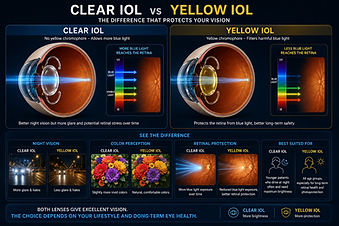
IOLs are available with different light-filtering properties. A clear IOL allows visible light to pass through without a noticeable colour tint. It provides excellent optical clarity and is very close to the appearance of a transparent artificial lens.
Some IOLs have a yellow chromophore, which filters ultraviolet (UV) light and some of the higher-energy blue-violet light. The purpose is to provide some additional protection against potentially harmful wavelengths while maintaining good vision and contrast.
Blue-blocking IOLs filter a greater proportion of blue-violet light. They are designed with the aim of reducing exposure to high-energy blue light and may be useful in selected patients. However, the difference between clear, yellow and blue-blocking lenses is usually much less important to day-to-day vision than the optical design of the IOL. Your surgeon can advise which option is appropriate for you.
4. Optical Design – How Much Spectacle Dependence Can Be Reduced?
The most important difference between modern IOLs is their optical design. This determines how well you can see at different distances after cataract surgery and how much you may need glasses.
-
A spherical monofocal IOL is the simplest optical design. It is usually selected to provide excellent vision at one main distance, most commonly distance vision. You will generally need reading glasses for near work. It is a reliable option that provides good-quality vision with relatively little optical complexity.
-
An aspherical IOL is an improved version of the monofocal lens. Its optical surface is specially designed to reduce certain optical imperfections of the eye. This can improve contrast and image quality, particularly in low-light conditions. Like a standard monofocal lens, it usually provides clear vision at one main distance, so reading glasses may still be required.
-
Advanced monofocal or enhanced monofocal IOLs are designed to provide a somewhat greater range of clear vision than a conventional monofocal lens. They may give better intermediate vision for activities such as using a computer, looking at a dashboard or seeing across a room, while still maintaining good distance vision. Some patients may therefore require glasses less frequently.
-
An EDOF (Extended Depth of Focus) IOL is designed to stretch the range over which vision remains clear rather than providing sharply separated focal points. It can provide good distance and intermediate vision and useful functional near vision in many patients. It is particularly attractive for people who spend considerable time on computers, mobile phones or other intermediate-distance activities. Reading glasses may still be required for very small print.
-
A multifocal or trifocal IOL uses different optical zones to provide vision at more than one distance—typically distance, intermediate and near. These lenses offer a greater possibility of being free from glasses for everyday activities. However, because they divide light between different focal points, some people may notice glare, halos around lights or a reduction in contrast, particularly at night. They therefore require careful patient selection and counselling.
-
A toric IOL is specially designed to correct astigmatism as well as the patient's basic spectacle power. If you have significant astigmatism, a toric lens can provide sharper unaided vision by reducing this additional focusing error. Toric lenses can be combined with different optical designs, including monofocal, EDOF and multifocal technologies.
The Goal – Greater Freedom From Glasses
In general, as we move from a standard monofocal lens → aspherical/advanced monofocal → EDOF → multifocal/trifocal or other advanced presbyopia-correcting lenses, the potential for greater spectacle independence increases.
However, less dependence on glasses does not necessarily mean a better lens for everyone. Some people value maximum optical clarity and night vision and are perfectly happy to use reading glasses. Others may prefer to minimise glasses for reading, computers, driving and everyday activities and are willing to accept some optical trade-offs.
Choosing the Right IOL for You
There is no single “best” IOL for every patient. The ideal lens depends on your eye health, corneal condition, amount of astigmatism, lifestyle, occupation, hobbies, night-driving requirements and your expectations regarding glasses.
Your surgeon will examine your eyes carefully and discuss these factors with you before recommending the IOL that provides the best balance between quality of vision and freedom from spectacles.
The aim is not simply to remove the cataract—it is to choose the right lens to give you the kind of vision you want after surgery.